Sunday, April 19, 2009

The Dao of Strategic Assessment (12): Assessing the Global Marketplace


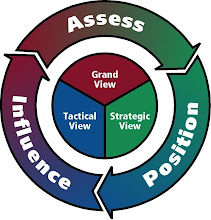
When assessing the grand picture of the U.S. economy, one must understand what are the "hot" political and economic influences before evaluating the marketplace.

In Jan. 2009, some associates told us that the U.S. economy will recover sometimes late this year. That the the upper tier banks have slowly begun to release money to the upper middle tier of our society. It will slowly trickle down to other parts of the economic value chain.

Many months ago, we saw the rate for a five yr CD was within the 1.0% range. In Feb., it was about 2.8%. At this moment, it is close to 3.5%. Progress!? Growth!? ... Recovery!? ... It is one of the many barometers that our associates used to assess and gauge the progress of the U.S. economy.

In Silicon Valley, chip manufacturing companies (i.e., Applied Material, Novellus Systems Inc., Intel, etc.) and network companies (i.e., Cisco Systems, etc.) are considered to be the bellwethers that kick-start the engine of the high technology economy.

Where the leading indicator of the semiconductor industry is the sale of voltage regulators - power supplies, my favorite gauge is the battery manufacturing companies. We will talk about this in a later post.

Overall, our research shows that the high technology and the biotechnology industries are the keys that will kick-start the global economy.

Whenever the banking industry stabilizes, we at C360 Consultants expected that the Silicon Valley region will “jump-start” some parts of the economy of the United States (and some parts of the global economy) in Sept. 2009.

We will continue this topic
later next month.

Collaboration360 Consultants (C360 Consultants). Copyright:2009 © All rights reserved. Copying, posting and reproduction in any form (without prior consent) is an infringement of copyright.

# # #

NEWS: Analyst - Strong IC rebound to start in second half
By Dylan McGrath
EE Times
(04/09/09, 06:49:00 PM EDT)

SAN FRANCISCO Spurred by pent-up electronic system demand and increasing average selling prices (ASPs), the IC market will register double-digit growth in 2010 and 2011 after beginning to recover in the second half of this year, according to market research firm IC Insights Inc.

Chip industry revenue in 2011 will surpass 2007 totals, according to the firm's current forecast, which is more optimistic than many others in the space in recent months. Gartner Inc. said in February that it does not see chip revenue returning to 2008 levels until 2013.

IC Insights (Scottsdale, Ariz.) is currently forecasting that overall IC industry revenue will decline 17 percent in 2009, followed by growth of 15 percent in 2010 and 19 percent in 2011. The proejctions are largely the same as the firm issued in January.

Bill McClean, president of IC Insights, told EE Times that his firm has been predicting double-digit growth for 2010 and 2011 for some time. A severe decrease in chip industry capital spending—the firm is now projecting it will decrease 39 percent in 2009—will result in a rapid increase in ASPs when demand begins to recover, he said.

"These supply issues are going to start turning the other way," McClean said. "When we see some seasonal strength in things like cellphones and consumer devices at the end of the year, I think people are going to be surprised about how quickly the market turns."

McClean said DRAM vendors are planning to spend, in total, $4 billion to $5 billion on capex in 2009, and the four leading foundries are planning to spend about $2 billion in total, both dramatic decreases from recent years. The result will be increases in average selling prices that have already begun, he said, adding that 2008 was the first year since 2004 that foundries showed increases in revenue per wafer.

"IC suppliers, I think there main focus is to get better pricing," McClean said. "These capex cutbacks are really going to force the issue."

Any surge in leading-edge IC unit demand could very quickly push 300-mm fab utilization rates to 90 percent or beyond, with an increase in ASPs trailing closely behind, IC Insights said. While first quarter utilization rates for 200-mm facilities hovered at only about 50 percent, 300-mm fab utilization rates for the first quarter ran at a fairly healthy 80 percent, the firm said.

A severe inventory burn in the first quarter of 2008 and first quarter of this year caused IC users to cut their order rates far below what is needed to sustain future electronic systems requirements, according to IC Insights. With IC inventory adjustments expected to be finished in the first half of the year, unit demand for ICs is expected to accelerate in the second half, the firm said.

IC Insights' observations about low inventories are consistent with what other market watchers have said in recent weeks. Last month, Jim Feldhan, president of Semico Research Corp., said lean inventories across the supply chain could jump-start a rapid IC recovery when the economy starts to improve. Last week, a venture capitalist said that chip inventories are at record lows and that the industry may have hit a "local bottom."

IC Insights said positive forces that are likely to drive growth in the worldwide economy later this year, including record low interest rates, low oil prices and more than $2 trillion in worldwide economic stimulus—less than 10 percent of which has been spent.

According to IC Insights, global recessions cause pent-up demand for electronics. A strong electronic systems and semiconductor industry rebound has followed each of the past four global recessions over the past 30 years, according to the firm.

"In IC Insights' opinion, given the extreme and unprecedented cutbacks in IC industry capital spending in 2008 and 2009, a surge in IC average selling prices in 2010 and 2011 is almost guaranteed," McClean wrote in a recent report. "This surge in IC ASPs will be the driving force for double-digit growth in the IC market over the next couple of years."

In the report, IC Insights offered two examples of companies anticipating an increase in demand later in 2009—foundry giant Taiwan Semiconductor Manufacturing Co. and automotive semiconductor supplier Melexis. Both companies are banking on better second halves to reach targets for 2009, the firm said.

"First quarter 2009 levels are so depressed, that in most cases, there will be a noticeable second-half over first-half 2009 increase in business," McClean wrote.

Semiconductor companies should not adjust their businesses— especially with regard to personnel cuts—to run at first quarter levels, given the expected increase in demand, IC Insights said. Unpaid leave, salary cuts and other measures may be the best approach to bridge the gap between the current weak level of business and the expected second-half recovery, according to the firm.

http://www.embedded.com/216500315?cid=NL_embedded


MARKET NEWS: Intel calls 'bottom' but market says hold on
By Bolaji Ojo
EE Times
(04/15/09, 10:00:00 AM EDT)
OEMs, corporate IT equipment buyers, consumers and industry analysts want to see the hard evidence before agreeing with the world's largest semiconductor company that the electronic market has hit bottom in terms of demand cutbacks.

Executives at Intel Corp. said in a statement announcing the company's first quarter results and in a follow-up conference call that demand for electronic components is no longer dropping as sharply as it did over the last six months, implying that sales could be on the upswing soon as manufacturers restock lean inventories and corporate IT buyers replace old equipment.

"We expect business conditions in the second quarter to mirror those in the first quarter with some gradual recovering of demand and replenishment of inventories occurring as the industry sees increasing signs of stabilization and a return to more normal seasonal trends," said Paul Otellini, Intel's president and CEO.

Otellini's optimism is hitting a wall of skepticism in the market place. Intel's stock price dipped more than 4 percent in after-market trading following the company's announcement of what appeared to be above-expectation first quarter results.

Similarly, a bunch of analysts covering the company indicated some disagreement with Intel's overall conclusion about the health of industry demand.

The sticky point was future demand in the face of continuing weakness in the global economy. With many regions of the world, including key markets in Europe and Japan, still fighting to turn their economies around, analysts are hesitant to conclude semiconductor sales will pick up strongly anytime soon.

In fact, many believe sales will remain flat and perhaps depressed until sometime in the third quarter of the year at the earliest.

"Despite the relatively enthusiastic pronouncements by the chipmaker, TBR believes that Intel will face challenges to grow its revenue and maintain profitability in 2009," said John Spooner, an analyst at Technology Business Research in Hampton, New Hampshire.

"We believe that the new realities of the market will exert considerable pressure on Intel's processor average selling prices as end-customers, both businesses and consumers, look for the greatest bang for the buck when and if in the case of businesses they move to purchase new PCs," he said. "We believe that, for the most part, 2009 PC sales growth increases will be on the lower-ends of the spectrum."

Morgan Stanley Research analyst Mark Lipacis has a similar conclusion: "While Intel called the bottom in PC demand, it was uncertain about the trajectory of demand, and indicated that enterprises as well as Europe, Japan and emerging markets still appear to be challenged," Lipacis said in a report.

Intel itself has not said it definitely expects demand for microprocessors to roar back strongly in coming months. While company executives said demand has stopped contracting they also declined for the second consecutive period to provide revenue forecasts for the ongoing quarter.

Instead, Intel said it expects sales to be flat from the first quarter, during which the company recorded revenue of $7.1 billion, down 26 percent from the year-ago comparable quarter and 19 percent from the fourth quarter.

First quarter net income shrank by more than half to $647 million, or 11 cents per share, from $1.44 billion, or 25 cents per share, in the first quarter of 2008. The company's gross margin tumbled to 45.6 percent, an improvement upon Intel's forecast for "the low-40 percent" but down from 54 percent in the year-ago quarter.

The company warned corporate equipment buyers are still holding off on new purchases and said demand in Europe and Japan remain depressed. The more price sensitive consumer market is helping to prop up demand, Intel said.

Intel is pinning its hope for future growth and margin improvements on several factors, including intensive cost-cutting activities, productivity increases, strong demand for next-generation processors, inventory replenishment at PC manufacturers and pent up demand from the corporate sector.

Additionally, demand visibility is beginning to improve, giving Intel a clearer look into future sales prospects, according to Otellini.

"The global environment hasn't changed but our ability to look at and plot some historical points has given us the confidence to essentially say that the industry has seen the bottom," said Otellini.

"Three months ago, we were sitting in a fragile global economic environment and we had just come off a horrendous fourth quarter and we weren't sure of [future] PC sales," he added. "Three months later we're still sitting in a fragile global economic environment but we've got three or four months of fairly good trending in terms of where the business is, what the inventory levels are, what geographies are still buying product and what segments are still buying products."

http://www.embedded.com/216500909?cid=NL_embedded

Wednesday, April 15, 2009

Best Practices of Desktop Strategists (4)


Another best practice is knowing how to assess almost anything regardless of its settings.

Regardless of the arena, one must know what are the standards and the ranking of valued data points.


#

Different Approach

The 49ers' approach in building the roster is far different than it used to be. No longer does the team adhere to the demands necessitated by the west coast offense and they are no longer run by the coaching staff. The team was once a coach-dominated organization, ultimately answering to the head coach and the man who invented their player acquisition system, Bill Walsh.


The 49ers have moved on from the Bill Walsh draft philosophy.

The late Bobb McKittrick, Walsh's long-time offensive line coach said the scouts did the ground work and brought all the information to the coaches. Then, they decided who to draft or sign in free agency. McKittrick also said that Walsh provided his coaches with broad leeway on whom they went after, because, ultimately, Walsh knew, for example, that McKittrick knew more about the offensive line than he did.

/// Even the genius knew that he does not know everything

Now, with a former scout in charge of the draft and free agency, the scouting department basically decides the roster and if the report from Sports Illustrated is to be believed, they don't necessarily tell the position coaches. S.I.'s Jim Trotter wrote that position coaches weren't consulted about the team's free-agent signings this year, specifically wide receiver Brandon Jones.

The coach dominated system keeps the staff more engaged, because if they're picking their own players, they are completely invested in seeing those players succeed and they feel more integral to the team's success.

Scouts, however, can provide a more subjective analysis of players.

Back in the Walsh era, the team looked for different types of players. The west coast offense wanted small, quick, intelligent offensive linemen, big wide receivers, dual-threat tight ends, and fullbacks who could catch.

The requirements often resulted in the 49ers competing by themselves for players. When Jerry Rice ran a slow 40-yard dash time, some teams dropped him on their draft boards. The 49ers didn't care. While teams increasingly looked for big, bruising linemen, the 49ers were content with the sub-300 pounder. That's why they were able to get Jesse Sapolu in the 11th round and Derrick Deese off the street. Rarely in the McKittrick era, did the 49ers expend a pick in the first three rounds on a lineman.

At quarterback, Walsh wanted accuracy, decision-making and intangibles. One former 49ers scout once said that if a passer could throw a ball 42 yards, that's all the arm strength needed for Walsh's offense (apparently Walsh's longest pass play went 35 yards, and then add in a seven step drop and you get 42 yards).

Ron Wolf knew how to build championships.

Ron Wolf knew how to build championships.

The current regime is much more from the Ron Wolf school, the former personnel man who won Super Bowls for the Raiders and Packers. Current general manager Scot McCloughan worked for Wolf in Green Bay.

Wolf wanted physical specimens for his teams. One former scout said he had an unbreakable rule that cornerbacks had to be over five-foot, 10-inches. If you measured five-feet, 9 and seven-eighths inches, Wolf wasn't interested.

In Oakland, Wolf was enamored with huge offensive lineman. The Raiders, in the 1970's, typically had the heaviest lines in the league. Wolf also liked strong-armed quarterbacks and fast receivers. In Green Bay, he modified his stance with the hiring of Walsh protege Mike Holmgren.

Nevertheless, Wolf wanted specimens at nearly every position. Big players don't get hurt as often as the undersized variety, and speed wins in the NFL, so Wolf was willing to look at measurables as much as production.

The late Tony Razzano, the 49ers long-time director of college scouting greatly favored college production over measurables.

The Wolf philosophy is definitely reflected in the 49ers' recent picks - consider tight end Vernon Davis (who ran a 4.38 40 at the combine but never caught more than 48 passes in one season at Maryland). Wide receiver Jason Hill was the fastest prospect at his combine and Joe Staley was the fastest offensive lineman at his.

Both Wolf and Walsh were outrageously successful at their crafts. But philosophies work as long as the people making decisions turn prospects into Pro Bowlers.

http://www.sfgate.com/cgi-bin/blogs/ninerinsider/detail?blogid=45&entry_id=38095#readmore

#

One should always remember that it is the implementers that make their strategic assessment process works.

Sunday, April 12, 2009

Applying the Art of War in Modern Warfare (1)


Regardless of the combat arena, military professionals follow some of the strategic guidelines that are stated in the Art of War.

///

Beating Somali Pirates at Their Own Game

By David Axe

After hitting the headlines last year, successful pirate attacks have been on the wane in the early months of 2009, despite a failed attack on a British cruise ship earlier this month. Experts disagree about what has led to the reduction, with some suggesting that bad weather had played its part, but Rear Adm. Terry McKnight of the U.S. Navy attributes the "dramatic" reduction in the number of attacks to the deployment of a British warship, the Royal Navy frigate HMS Northumberland, and the coordinated task force of which she is part.

To wage today's battles against pirates who took control of 42 ships and captured 815 sailors last year, the Royal Navy is combining machines and methods forged during the Cold War with centuries-old naval warfare skills. The Royal Navy is also hitting back at pirates by using some of the pirates' own tricks.

Fighting back
When Northumberland slipped out of Mombasa harbor in southern Kenya at the end of last year, a few reporters and gawkers stood on the banks. On the deck of the 460-foot frigate, a smattering of British sailors gazed back. As far as send-offs go, Northumberland's was low-key, but the understated nature of the departure belied the importance of her mission. On that hot December morning, Northumberland — one of just 17 such ships in the Royal Navy — opened up a new front in the unprecedented international war on Somali pirates.

Most of the other warships deployed to fight pirates in the region are concentrated north of Somalia, close to the Suez Canal, through which 10 percent of the world's sea trade passes. Northumberland was the first warship on the scene from a new European Union task force, charged with patrolling the southern flank of the 2-million-square-mile piracy zone, near Mombasa. It was here that pirates scored their biggest victory last autumn, seizing the supertanker Sirius Star, laden with $100 million in crude oil.

Besides Sirius Star, Somali sea bandits hijacked more than 40 large vessels last year, ransoming about 30 of them for a million U.S. dollars or more, according to the United Nations. Sirius Star was released in January after an estimated $3 million ransom was paid, but the other ships, and about 200 crew, remain in pirates' hands. The rise in piracy, and consequent rise in the cost of shipping insurance, drove up the cost of shipping petroleum, electronics and food.

Motherships
/// *** Speed is the essence of war. - Sunzi

To beat pirates in potentially violent showdowns, the Navy has adopted the pirates' tactics of using "mother ships" carrying fast boats to spring on opponents.

In the early days of Somali piracy, in the 1990s, pirates ranged only a few miles from their hometowns and threatened just a few thousand square miles of ocean. The reason was simple: Most pirates were former fishermen and had only the tools of a typical fishermen. Their personal firearms and their small, motor-propelled wooden fishing boats, called skiffs. The skiffs were too slow and too flimsy to catch anything but the most rickety of vessels.

Then the pirates innovated. They began capturing trawlers and small freighters for use as motherships. Crewman Juma Mvita, from the Kenyan merchant ship Semlow, discovered this the hard way in 2005, when about a dozen armed Somalis intercepted his ship. Mvita said the pirates had no interest in Semlow's cargo. Instead, they commandeered the harmless-looking freighter to launch their next attack. It was more than three months before the pirates released Semlow and her crew.

/// *** All warfare is based on deception.

Today, pirates use motherships for nearly all their attacks. "What we tend to see happen is a mothership will ... drag along a couple skiffs with it and have probably 10 or 15, 20 pirates on board, and then they'll send the skiffs out to go after a merchant vessel," McKnight said. He commands a new three-ship, counter-pirate task force.

Warships assigned to piracy patrols rarely engage pirates on their own. They deploy specialized search-and-seizure teams, which in the Royal Navy consist of marines armed with rifles and machine guns, traveling in raider craft. It was one such team from the frigate HMS Cumberland that killed three pirates in a firefight last November.

Boarding teams
Boarding teams have been a part of British warship crews for centuries, but in recent years they've become the best weapon against enemies such as pirates. The Cumberland's actions are "bound to have an impact on pirates," said Capt. Mike Davis-Marks, a Royal Navy spokesman. "Now suddenly there's the threat of death and this may force them to think again."

Cumberland's encounter was typical, if still rare in a conflict in which most navies are focused on deterrence rather than active fighting. A naval engagement with pirates often begins with a commercial ship reporting an attack, using a radio frequency set aside for emergency calls. Other times, a maritime patrol plane, usually flying from Djibouti, spots a potential mothership or pirate skiff, identifiable not by its appearance, but by its vector. A trawler speeding away from Somalia, toward a slow-moving tanker ship, just might have hostile intentions.

Digital deconfliction
Naval commanders, in touch with each other by phone, e-mail and satellite network, sort through the roster of warships in the region to figure out who might respond fastest. They call this "deconfliction." When the responding ship is close enough, it launches a helicopter to scout ahead and confirm that the suspect seafarers are indeed armed, while preparing to lower the boarding teams' boats into the water.

In Cumberland's case, "the ship's presence alone was often enough to prevent pirate attacks," the Ministry of Defense reported. Beyond that, the helicopter might deter pirates simply by "flying close to demonstrate the aircraft's machine gun and giving the pirates warning of their serious intentions."

If the pirates persist, the boarding teams deploy, flanking the pirates' boats to approach from both sides, moving fast with weapons at the ready. If the pirates lay down their weapons, they are taken into custody without a shot fired. If they shoot, the boarding teams fire back, then climb aboard.

The naval network
Deterring an attack, or winning a firefight, requires first that a warship be nearby when pirates strike. With pirates active on millions of square miles of ocean, blending in with harmless fishing boats, that's no easy task.

Today on the Indian Ocean there are 20 warships from 14 nations, all of them sent by their governments over the past six months to protect vital shipping from pirates. Coordinating these ships is key to providing the widest possible protection against pirates. In the beginning, it was a free-for-all. "It's encouraging that everyone is here," Lt. Nathan Christensen, a U.S. Navy spokesman, said last autumn, "but everyone's got their own rules of engagement ... their own commanders."

In time, the naval forces coalesced into four distinct entities plus some odds and ends. There was the U.S.-dominated Combined Task Forces 150 and 151, the latter commanded by McKnight. There was a NATO force sent on a temporary basis, and the EU flotilla intended eventually to replace the NATO one. On the fringes, there were warships from Russia, India and several other navies, sailing and fighting all on their own.

The four large, multi-ship formations had just one thing in common. Each one had a British warship assigned: Cumberland with NATO, Northumberland with the EU, the frigate HMS Portland in CTF-151 and, in CTF-150, a rotation of British frigates, destroyers and logistics ships.

That was no accident. In the last decade, the Royal Navy has mothballed nearly a third of its frigates and destroyers and canceled some new ships and technologies in a bid to save money, but the Royal Navy never cut back on its training and command capabilities.

///*** Victory is the main object in war. If this is long delayed, weapons are blunted and morale depressed. When troops attack cities, their strength will be exhausted. - Sunzi

"Our ships are not necessarily better than those of other navies," said Capt. Malcolm Cree, a commander for international naval forces in the Persian Gulf. "The one thing that we do have, the jewel in the crown of the Royal Navy, is our operational sea training.... As a result, Royal Navy ships and staffs provide a consistent level of professionalism capability that others know they can rely on."

///*** "You should arrange the employment of terrain so that it will be easy for the horses; the horses so that they will easily pull the chariots; the chariots so that they will easily convey the men; and the men so that they will easily engage in battle." -Wu Tzu, 3

It was that professionalism that the EU enlisted when it sent Northumberland to test the pirates' southern flank in December. And it was that professionalism that eventually helped tie together the tangle of naval forces threading the Indian Ocean to deter pirates.

By January, some order had been imposed on the chaos. McKnight's CTF-151 and the EU flotilla, under the command of British Rear Adm. Phillip Jones, were acting as the major nodes in a radio, e-mail and satellite communications network connecting most of the warships in the Indian Ocean. "My biggest concerns are coordination and deconfliction," McKnight said. "It appears that it's been working pretty fairly in the last couple of months."


The legal front
As boarding teams engaged pirates in firefights and commanders were sorting out the naval traffic jam in the Indian Ocean, a parallel battle was taking place on dry land. Late last year, there was "a lack in U.K. law of clear arrest and evidence-gathering powers for Royal Navy officers," the House of Commons recalled in a report in January. "If Royal Navy officers were to arrest pirates, there was a real risk that such prosecution would fail on procedural grounds if they were brought back to the U.K. for prosecution."

That legal loophole is one that pirates have exploited for years. After two decades of civil war, Somalia has no coast guard and no functional courts, and the only organizations in a position to intercept pirates — the world's navies — have no clear legal powers.

"The potentials for legal embarrassments are quite numerous," said Martin Murphy, a piracy analyst at the Centre for Strategic and Budgetary Assessments. So when they captured pirates, many navies simply deposited them on the nearest Somali beach. Needless to say, in those cases the pirates probably returned to their lives of crime.

What the world needed was a stable, democratic country in East Africa, with a stake in the piracy fight and the ability to detain, try and jail pirates. What the world needed, in fact, was Kenya. The United Kingdom, with close ties to its former colony, was the first to draw Kenya into the counter-piracy coalition in a legal capacity. Moses Wetang'ula, the Kenyan foreign minister, and Alan West, the British security minister, met at a piracy conference in Nairobi to initiate the agreement, and none too soon: Eight Somali pirates already were being held in a Kenyan jail, on soft legal grounds, after being captured by a British frigate.

The United States was quick to follow Britain's example. In January, the U.S. State Department signed a similar agreement with Kenya. "The lawyers are at work for the particulars," McKnight said, "and as soon as we get those mechanisms in place, then we will shift our operation." Instead of just reacting to pirates, McKnight's task force would go on the attack.

Aggressive action can't come too soon. "Pirates are winning," Murphy said late last year.

///*** Now being victorious in battle is easy, but preserving the results of victory is difficult. Thus it is said that among the states under Heaven that engage in warfare, those that garner five victories will meet with disaster; those with four victories will be exhausted; those with three victories will become hegemons; those with two victories will be kings; and those with one victory will become emperors. For this reason those who have conquered the world through numerous victories are extremely rare, while those who thereby perished are many. -Wu Tzu

Back off the coast of Mombasa in December, Northumberland made final preparations for her mission. In the frigate's scrubbed and polished compartments, sailors calibrated their sensors and fueled up a gray-painted Merlin helicopter. Royal Marines checked the rifles and kit. The vessel veered northward, toward Somalia. "We remain ready," said Commander M.J. Simpson, Northumberland's skipper.

If pirates really are less aggressive this year, the world has the Royal Navy, in particular, to thank. If not, and if this most ancient form of lawlessness continues to sap the global economy, nations will keep looking to the United Kingdom to help fight piracy.

///*** Thus, what is of supreme importance in war is to attack the enemy's strategy; Next best is to disrupt his alliances. The next best is to attack his army. The worst policy is to attack cities. Attack cities only when there is no alternative. -Sunzi

---
This article originally appeared on Wired.co.uk.
http://www.wired.com/politics/security/news/2009/04/somali_pirates

Thursday, April 9, 2009

The Dao of Strategic Assessment (11): Assess, Never Assume


/// Have been sitting in the archives. Forgot to post it.

I am a big fan of Tom Friedman. Enjoyed most of his books. However, this is one time Mr. Tom believed his press report of "everything he say is perfect."

In his Feb article on risk-takers, Mr. Friedman did not know about the low success rate of launching a startup. For every Google, there are many startups like Profusion. Interestingly, he also did not stated the ratio between successful startups and failed startups.

Many years ago, I read an article on the success rate of VC investment. It stated that 10 out of every 100 startups succeed within the first year. From those 10 startups, about 50% succeeds in surviving the second year. By the third year, 50% of that number survives. The road to success is never easy for the VC and the entrepreneur
.

Mr. Friedman's poor assumption means that he did not assess the grand picture of venture capital properly.


#

Another Reason Friedman's Wrong: Most Startups Bomb
Joe Weisenthal| Feb. 23, 2009, 1:23 PM|

Earlier, John Carney pointed out a major flaw in Tom Friedman's plan to subsidize the VC industry and startups. Top investors aren't wanting for cash, so any government money would flow towards lower tier investors, and lower tier companies, likely leading to a big mis-allocation of wealth.

Here's another big problem. Innovative startups aren't the cure-all they're made out to be.

Sure, it'd be great to plant the seeds of another 100 Googles, but alas, most startups aren't Google. Actually, most startups crash and burn. Just look over the last few years. Even in the absence of extra government money -- just a normal market scenario -- investors seeded way too many trash companies. Companies got funding despite ideas that were so half-baked you knew they were DOA the moment you heard of them. They still are, even today. And the data bears this out.

The American magazine looked at the 'startup myth' in a piece from January: To get more economic growth by having more start-ups, new companies would need to be more productive than existing companies. But they’re not.

A study by economists John Haltiwanger, Julia Lane, and James Spletzer, published in the American Economic Review Papers and Proceedings, combined data from the U.S. Census and other sources to look at the relationship between firm productivity and firm age. The results showed that firm productivity increases with firm age. This means that the average new firm makes worse use of resources than the average existing firm, which is not what you would expect if economic growth benefits more from the creation of new firms than from the expansion of existing ones. And you shouldn’t think that the typical start-up makes up for its poor productivity when it gets older, because the typical start-up is dead in five years.

This is not to say that we don't need startups. Obviously we do, and some of our most significant quality-of-life enhancements come from innovative startups. But we suffer from mental selection bias, because we think of startups as though they're all potential Googles (a rare startup winner), rather than their most likely outcome, which is a total time and capital sink that should never have gotten off the napkin.

http://www.businessinsider.com/another-reason-friedmans-wrong-startups-suck-2009-2

Here is a link to Thomas Friedman's article on startups

Wednesday, April 8, 2009

The Dao of the Global Game


In a global economy, the marketplace is the real battlefield. Regardless of their goal and the strategic approach, the focus of these game players is to know the true aim of the other competitor.


The typical modus operandi of one strategist is to implement a deceptive image, then quietly execute a macro set of schemes to bait and lure the opposition in. He or she uses his vast network of pawns like stones on a Go board.

The other strategist wheels and deals by utilizing his/her strategic network to gain access to their target. Then he/she influences the target by finding a psychological tactic in order to make a connection. Once the connection is established, he/she uses a set of hidden specifics to gain the advantage.

When two parties are stuck in "a rock and a hard place" situation, it becomes a game of chicken. Who is going to commit the first major error?

#


The preferred mindset of the Asian strategic thinkers is based on the game of Go (It is also known as igo (Japanese), weiqi (Chinese) or baduk (Korean)) The objective of the game is to surround the opposition by occupying more territory than the opposition.


There are some western strategic thinkers that utilizes the poker mindset (and/or other US dominated professional sports). To them, it is all about the following strategic actions of opening, calling, checking, raising and folding.


#


April 3, 2009
Op-Ed Columnist
China’s Dollar Trap
By PAUL KRUGMAN

Back in the early stages of the financial crisis, wags joked that our trade with China had turned out to be fair and balanced after all: They sold us poison toys and tainted seafood; we sold them fraudulent securities.

/// The masses always suffer. The elite rarely suffer.

But these days, both sides of that deal are breaking down. On one side, the world’s appetite for Chinese goods has fallen off sharply. China’s exports have plunged in recent months and are now down 26 percent from a year ago. On the other side, the Chinese are evidently getting anxious about those securities.

But China still seems to have unrealistic expectations. And that’s a problem for all of us.

The big news last week was a speech by Zhou Xiaochuan, the governor of China’s central bank, calling for a new super-sovereign reserve currency.”

The paranoid wing of the Republican Party promptly warned of a dastardly plot to make America give up the dollar. But Mr. Zhou’s speech was actually an admission of weakness. In effect, he was saying that China had driven itself into a dollar trap, and that it can neither get itself out nor change the policies that put it in that trap in the first place.

Some background: In the early years of this decade, China began running large trade surpluses and also began attracting substantial inflows of foreign capital. If China had had a floating exchange rate like, say, Canada this would have led to a rise in the value of its currency, which, in turn, would have slowed the growth of China’s exports.

But China chose instead to keep the value of the yuan in terms of the dollar more or less fixed. To do this, it had to buy up dollars as they came flooding in. As the years went by, those trade surpluses just kept growing and so did China’s hoard of foreign assets.

Now the joke about fraudulent securities was actually unfair. Aside from a late, ill-considered plunge into equities (at the very top of the market), the Chinese mainly accumulated very safe assets, with U.S. Treasury bills T-bills, for short making up a large part of the total. But while T-bills are as safe from default as anything on the planet, they yield a very low rate of return.

Was there a deep strategy behind this vast accumulation of low-yielding assets? Probably not. China acquired its $2 trillion stash turning the People’s Republic into the T-bills Republic the same way Britain acquired its empire: in a fit of absence of mind.

And just the other day, it seems, China’s leaders woke up and realized that they had a problem.

The low yield doesn’t seem to bother them much, even now. But they are, apparently, worried about the fact that around 70 percent of those assets are dollar-denominated, so any future fall in the dollar would mean a big capital loss for China. Hence Mr. Zhou’s proposal to move to a new reserve currency along the lines of the S.D.R.’s, or special drawing rights, in which the International Monetary Fund keeps its accounts.

But there’s both less and more here than meets the eye. S.D.R.’s aren’t real money. They’re accounting units whose value is set by a basket of dollars, euros, Japanese yen and British pounds. And there’s nothing to keep China from diversifying its reserves away from the dollar, indeed from holding a reserve basket matching the composition of the S.D.R.’s nothing, that is, except for the fact that China now owns so many dollars that it can’t sell them off without driving the dollar down and triggering the very capital loss its leaders fear.

So what Mr. Zhou’s proposal actually amounts to is a plea that someone rescue China from the consequences of its own investment mistakes. That’s not going to happen.

And the call for some magical solution to the problem of China’s excess of dollars suggests something else: that China’s leaders haven’t come to grips with the fact that the rules of the game have changed in a fundamental way.

Two years ago, we lived in a world in which China could save much more than it invested and dispose of the excess savings in America. That world is gone.

Yet the day after his new-reserve-currency speech, Mr. Zhou gave another speech in which he seemed to assert that China’s extremely high savings rate is immutable, a result of Confucianism, which values anti-extravagance.” Meanwhile, it is not the right time” for the United States to save more. In other words, let’s go on as we were.

That’s also not going to happen.

The bottom line is that China hasn’t yet faced up to the wrenching changes that will be needed to deal with this global crisis. The same could, of course, be said of the Japanese, the Europeans and us.

And that failure to face up to new realities is the main reason that, despite some glimmers of good news the G-20 summit accomplished more than I thought it would this crisis probably still has years to run.

Copyright 2009 The New York Times Company

http://www.nytimes.com/2009/04/03/opinion/03krugman.html