Thursday, April 9, 2009

The Dao of Strategic Assessment (11): Assess, Never Assume


/// Have been sitting in the archives. Forgot to post it.

I am a big fan of Tom Friedman. Enjoyed most of his books. However, this is one time Mr. Tom believed his press report of "everything he say is perfect."

In his Feb article on risk-takers, Mr. Friedman did not know about the low success rate of launching a startup. For every Google, there are many startups like Profusion. Interestingly, he also did not stated the ratio between successful startups and failed startups.

Many years ago, I read an article on the success rate of VC investment. It stated that 10 out of every 100 startups succeed within the first year. From those 10 startups, about 50% succeeds in surviving the second year. By the third year, 50% of that number survives. The road to success is never easy for the VC and the entrepreneur
.

Mr. Friedman's poor assumption means that he did not assess the grand picture of venture capital properly.


#

Another Reason Friedman's Wrong: Most Startups Bomb
Joe Weisenthal| Feb. 23, 2009, 1:23 PM|

Earlier, John Carney pointed out a major flaw in Tom Friedman's plan to subsidize the VC industry and startups. Top investors aren't wanting for cash, so any government money would flow towards lower tier investors, and lower tier companies, likely leading to a big mis-allocation of wealth.

Here's another big problem. Innovative startups aren't the cure-all they're made out to be.

Sure, it'd be great to plant the seeds of another 100 Googles, but alas, most startups aren't Google. Actually, most startups crash and burn. Just look over the last few years. Even in the absence of extra government money -- just a normal market scenario -- investors seeded way too many trash companies. Companies got funding despite ideas that were so half-baked you knew they were DOA the moment you heard of them. They still are, even today. And the data bears this out.

The American magazine looked at the 'startup myth' in a piece from January: To get more economic growth by having more start-ups, new companies would need to be more productive than existing companies. But they’re not.

A study by economists John Haltiwanger, Julia Lane, and James Spletzer, published in the American Economic Review Papers and Proceedings, combined data from the U.S. Census and other sources to look at the relationship between firm productivity and firm age. The results showed that firm productivity increases with firm age. This means that the average new firm makes worse use of resources than the average existing firm, which is not what you would expect if economic growth benefits more from the creation of new firms than from the expansion of existing ones. And you shouldn’t think that the typical start-up makes up for its poor productivity when it gets older, because the typical start-up is dead in five years.

This is not to say that we don't need startups. Obviously we do, and some of our most significant quality-of-life enhancements come from innovative startups. But we suffer from mental selection bias, because we think of startups as though they're all potential Googles (a rare startup winner), rather than their most likely outcome, which is a total time and capital sink that should never have gotten off the napkin.

http://www.businessinsider.com/another-reason-friedmans-wrong-startups-suck-2009-2

Here is a link to Thomas Friedman's article on startups

Wednesday, April 8, 2009

The Dao of the Global Game


In a global economy, the marketplace is the real battlefield. Regardless of their goal and the strategic approach, the focus of these game players is to know the true aim of the other competitor.


The typical modus operandi of one strategist is to implement a deceptive image, then quietly execute a macro set of schemes to bait and lure the opposition in. He or she uses his vast network of pawns like stones on a Go board.

The other strategist wheels and deals by utilizing his/her strategic network to gain access to their target. Then he/she influences the target by finding a psychological tactic in order to make a connection. Once the connection is established, he/she uses a set of hidden specifics to gain the advantage.

When two parties are stuck in "a rock and a hard place" situation, it becomes a game of chicken. Who is going to commit the first major error?

#


The preferred mindset of the Asian strategic thinkers is based on the game of Go (It is also known as igo (Japanese), weiqi (Chinese) or baduk (Korean)) The objective of the game is to surround the opposition by occupying more territory than the opposition.


There are some western strategic thinkers that utilizes the poker mindset (and/or other US dominated professional sports). To them, it is all about the following strategic actions of opening, calling, checking, raising and folding.


#


April 3, 2009
Op-Ed Columnist
China’s Dollar Trap
By PAUL KRUGMAN

Back in the early stages of the financial crisis, wags joked that our trade with China had turned out to be fair and balanced after all: They sold us poison toys and tainted seafood; we sold them fraudulent securities.

/// The masses always suffer. The elite rarely suffer.

But these days, both sides of that deal are breaking down. On one side, the world’s appetite for Chinese goods has fallen off sharply. China’s exports have plunged in recent months and are now down 26 percent from a year ago. On the other side, the Chinese are evidently getting anxious about those securities.

But China still seems to have unrealistic expectations. And that’s a problem for all of us.

The big news last week was a speech by Zhou Xiaochuan, the governor of China’s central bank, calling for a new super-sovereign reserve currency.”

The paranoid wing of the Republican Party promptly warned of a dastardly plot to make America give up the dollar. But Mr. Zhou’s speech was actually an admission of weakness. In effect, he was saying that China had driven itself into a dollar trap, and that it can neither get itself out nor change the policies that put it in that trap in the first place.

Some background: In the early years of this decade, China began running large trade surpluses and also began attracting substantial inflows of foreign capital. If China had had a floating exchange rate like, say, Canada this would have led to a rise in the value of its currency, which, in turn, would have slowed the growth of China’s exports.

But China chose instead to keep the value of the yuan in terms of the dollar more or less fixed. To do this, it had to buy up dollars as they came flooding in. As the years went by, those trade surpluses just kept growing and so did China’s hoard of foreign assets.

Now the joke about fraudulent securities was actually unfair. Aside from a late, ill-considered plunge into equities (at the very top of the market), the Chinese mainly accumulated very safe assets, with U.S. Treasury bills T-bills, for short making up a large part of the total. But while T-bills are as safe from default as anything on the planet, they yield a very low rate of return.

Was there a deep strategy behind this vast accumulation of low-yielding assets? Probably not. China acquired its $2 trillion stash turning the People’s Republic into the T-bills Republic the same way Britain acquired its empire: in a fit of absence of mind.

And just the other day, it seems, China’s leaders woke up and realized that they had a problem.

The low yield doesn’t seem to bother them much, even now. But they are, apparently, worried about the fact that around 70 percent of those assets are dollar-denominated, so any future fall in the dollar would mean a big capital loss for China. Hence Mr. Zhou’s proposal to move to a new reserve currency along the lines of the S.D.R.’s, or special drawing rights, in which the International Monetary Fund keeps its accounts.

But there’s both less and more here than meets the eye. S.D.R.’s aren’t real money. They’re accounting units whose value is set by a basket of dollars, euros, Japanese yen and British pounds. And there’s nothing to keep China from diversifying its reserves away from the dollar, indeed from holding a reserve basket matching the composition of the S.D.R.’s nothing, that is, except for the fact that China now owns so many dollars that it can’t sell them off without driving the dollar down and triggering the very capital loss its leaders fear.

So what Mr. Zhou’s proposal actually amounts to is a plea that someone rescue China from the consequences of its own investment mistakes. That’s not going to happen.

And the call for some magical solution to the problem of China’s excess of dollars suggests something else: that China’s leaders haven’t come to grips with the fact that the rules of the game have changed in a fundamental way.

Two years ago, we lived in a world in which China could save much more than it invested and dispose of the excess savings in America. That world is gone.

Yet the day after his new-reserve-currency speech, Mr. Zhou gave another speech in which he seemed to assert that China’s extremely high savings rate is immutable, a result of Confucianism, which values anti-extravagance.” Meanwhile, it is not the right time” for the United States to save more. In other words, let’s go on as we were.

That’s also not going to happen.

The bottom line is that China hasn’t yet faced up to the wrenching changes that will be needed to deal with this global crisis. The same could, of course, be said of the Japanese, the Europeans and us.

And that failure to face up to new realities is the main reason that, despite some glimmers of good news the G-20 summit accomplished more than I thought it would this crisis probably still has years to run.

Copyright 2009 The New York Times Company

http://www.nytimes.com/2009/04/03/opinion/03krugman.html

Sunday, April 5, 2009

The Dao of Strategic Assessment (10): Assess, Never Assume

Never assume. Always assess first.

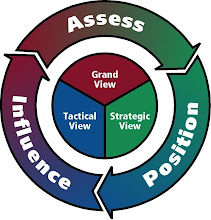
While assessing the goal, always check the grand settings. Understand the direction of the momentum, the scope, the time line, the metrics and the risks.

Our Compass AE process is based on defining the outcome first. Once it is delineated, one understands the direction of the project. Then it becomes easier for the project strategist to establish the operational specifics of the project.

We will touch on the topic of top-down thinking in later posts.


When You Assume
Andy Clark

April 1, 2009

The plan looks good on paper. Competent professionals are executing it. But unexpected delays and costs still crop up. It could be the one area of project management where your years of experience can actually hurt you: assumptions. So how do you weed them out of your plan? Here are some unassuming ideas.

It happened to me again last week in the initiation phase of an Archiving Implementation project. We completed a successful proof of concept and were moving ahead with the implementation, which required a refreshed database. I had asked the database administrators (DBAs) how long it would take to build the refresh and they answered “4 hours.” I assumed this was a full estimate of the time required for the refresh, based on my experience working with DBAs on similar activities. What I didn’t realize is that changes in storage technology had changed our refresh procedures and this was now a System Administrator operation as much as a DBA operation. Consequently the estimate did not include either the System Administrator work or the coordination work.


I hadn’t waited until the last minute to get started, so this false assumption didn’t cause a delay in the project’s critical path, but it did cost some of my time and caused work to be done on a quasi-emergency basis rather than as a planned activity.


Every time I turn around, I run into an assumption. I’ve seen system tests delayed because lab configuration wasn’t complete; rollouts delayed because user documentation wasn’t in a usable format; and meetings delayed because key participants were on vacation.

Many times I’ve seen a plan that looks good on paper, executed by qualified professionals, get hammered with delays caused by assumptions. It’s easy to do, and it’s the one area of project management where your own experience can actually betray you. You evaluate and estimate an activity based on previous experiences, but don’t realize that there have been changes in the business environment that render these estimates invalid.

How do you avoid falling victim to assumptions? Here are some techniques that can help:
· Review your requirements and deliverables
· Question estimates
· Know the project team
· Consider stakeholders
· Pay attention to risk management
· Don’t be afraid to ask the obvious question
· Document (!!)

Carefully reviewing a project’s requirements and deliverables can identify many assumptions as you build the WBS, schedule and the other planning documents.


For example if a project requires status reports, who will draft them? How will the information be gathered and distributed, and in what format? Where will they be retained? Is there any special content that the sponsor or other stakeholders are looking for? Is there a specific time they want to see them and what time period do they want covered? Is there a part of the project they (or you) are particularly interested in tracking? Are there any accessibility or language considerations? Many of these questions have simple answers that will be right 99 percent of the time. However, notice how many questions come up for building status reports, and this is usually a very straightforward deliverable. By the time you finish walking through a moderately complex project there will be hundreds of these questions and your chances of missing one of those “99 percent certainty” questions is quite high.

You should always examine any estimates closely, even those you make yourself.How confident is the estimator? What resources is he or she depending on? Which of these resources do you not have firm control over? How much coordination and communications are required for the task? How recently has the estimator done this type of work? Generating an estimate that states, “We’ll need a developer to spend 16 hours developing a login page” is not enough. It is crucial to identify all of the resources and coordination required for each task. Otherwise there is a good chance that something will come up — for example, the coder will not have access to your directory services system for user authentication and you’ll lose a week waiting for that to happen.


Now you are ready to take a close look at the project team. Are there tasks that require a specific skill-set that is not on your team? For example, does your project require DBAs, or some other specialty, for several key tasks? If so, you should look to add or reserve someone with the right skills on at least a part time basis. In a similar vein, you also need to be careful when project staff has other commitments. When you have project members on multiple projects you need to be sure you know where your project falls “in the stack.” When your project members also support operational systems this can take them completely off your project at any time. Be prepared.


Always consider the stakeholders. Some project managers fall into the trap of paying so much attention to the project team’s requirements, that they ignore the stakeholders requirements. Many projects depend heavily on stakeholders for training, testing and documentation activities. Virtually all projects depend on stakeholders to verify and accept deliverables. Give careful thought to what stakeholders will need to perform their duties. If you are relying on stakeholders for testing or verification, they will likely need help in defining test plans and test cases. Consider what type of training, access and reports your stakeholders will need. Investing time in helping your stakeholders be effective participants is time well spent.


You may have noticed that the type of work you do in identifying assumptions bears a strong resemblance to Risk Identification. The two efforts really do work hand in hand. Any assumption is a risk, so doing due diligence in risk management will help you identify assumptions and vice versa. In addition, you should be alert for new assumptions when you are working your way through Risk Analysis and especially Risk Response Planning. If your contingency plan for losing your database server is to move your database to another server, then you are assuming that both servers will not be simultaneously offline for an extended period of time. Hopefully, these two servers are not on two virtual machines located on the same physical server.


Good project managers ask questions even when the answer seems obvious. Questions, even seemingly easy questions, make people think. When you ask the system engineer whether a 50-teraflop graphics processor can handle the forms processing video, he may realize that, while processor power is not a problem, memory and storage could be. The obvious question often is not as obvious as you think, and sometimes it leads others to spot problems that you might overlook. These types of questions will help you get the best from your team.

Finally, make sure that your assumptions are documented in appropriate places — the Project Charter, Risk Management Plan and Project Requirements Document, for starters. This needs to be done for all of the usual political reasons, but it also helps identify new assumptions. Writing documents and asking questions are the best ways to nudge team members into identifying new risks.

These best practices can help, but in all probability you will not identify all assumptions. It’s easy to overlook the possibility that a team member will be sick at a crucial point, a virus will infect your workstation, or that your sponsor will be transferred to a different position. In fact, it’s probably not worthwhile to try to find everything, but you need to do what you can.

In the case of my archiving project, the problem with the refresh did not delay the project because the refresh was not started at the end of its slack period. Slack time is a gift on a busy project. Typically that gift is spent working on other activities, but whenever possible, start tasks as early as possible, lest you discover that your project has a new critical path.

These concepts, like much of project management, are mostly common sense. However, if you believe that common sense is the same as common practice, then you are making a really bad assumption.


Andy Clark is a Lead for the Virginia Community College System, one of the largest integrated higher education systems in the world. In this capacity, he routinely leads projects with dozens of engaged stakeholders. His 25 years of project management experience encompasses projects of all sizes in both the public and private sector.

Copyright © 2009 projects@work All rights reserved.
The URL for this article is:
http://www.projectsatwork.com/article.cfm?ID=248406


http://www.projectsatwork.com/content/Articles/248406.cfm

Sunday, March 29, 2009

The Dao of Strategic Maneuverability


Speed is the essence of war. - Sunzi

In combat, there is always a trade-off between speed, maneuverability, carrying personnel ability, high impact firepower and armor.

Sometimes there are those who consciously believe that they are in midst of a video game and are moving at mind-breaking speed. Their perception is that they are invincible

When negative consequences strike, injuries occur, they realized that they are not playing in a video game and their reality is painful and harsh.

Sidebar: When building a Tangible Vision of this magnitude, one must properly decide on the ranking of the technical values. It should be based on time, resources and tangibility.


An Intangible Vision is Always Unrealistic
Paraphrasing from the essays of Master Ghost Valley, "Perception is not always reality."

To achieve the essence of "perception is reality", the task-objectives of competitive intelligence and strategic assessment must be consummate and continuous.

Sidebar: Other people have believe that their state of conscious awareness can be heightened through the various practice of yoga and internal martial arts.


#

March 10, 2009
Too Much Armor Robbing Marines of Speed in Combat

By THE ASSOCIATED PRESS

Filed at 1:23 p.m. ET

WASHINGTON (AP) -- Using heavy layers of armor to keep troops safe from bullets and bombs is making the Marine Corps too slow on a battlefield where speed and mobility are critical, a senior military leader said Tuesday.

With 8,000 Marines about to be sent to Afghanistan to quell rising violence, Lt. Gen. George Flynn cautioned members of Congress against wrapping them in so much protective gear they can't hunt down more agile insurgents who use the country's rugged peaks and valleys to their advantage.

''The bottom line is that the focus on armor as the principal means of protecting our force is making us too heavy,'' said Flynn, deputy commandant of the Marine Corps for combat development and integration, during a hearing held by the House Appropriations defense subcommittee.

The weight of personal body armor and steel-encased vehicles limits the speed and maneuverability that make the Marine Corps ''more effective and deadly to the enemy,'' he said.

Body armor has been a proven lifesaver of U.S.. troops. But the vests weigh as much as 34 pounds each. When body armor is added to the assault rifles, ammunition, water and other essential gear troops are required to carry, they can be lugging as much as 80 pounds into combat. Besides moving more slowly, overburdened troops tire more quickly and are prone to orthopedic injuries that can take them out of action, officials say.

Convincing a war-weary public of a less-is-more approach won't be easy, they say. If a commander decides the gear shouldn't be used for a particular mission and a service member is killed, there could be a backlash, said Jean Malone, deputy director of experiment plans at the Marine Corps Warfighting Lab in Quantico, Va.

''We've got to have the internal fortitude to come back and say: 'We have the data. We made the right decision. We can't guarantee you that nobody will die in this war,''' he said.

Paring down the amount of armor could actually make troops safer on the battlefield, officials say. Speed and maneuverability give them the best chance of killing or capturing the Taliban and other militants before they can set roadside bombs or get in position for an ambush.

''Being able to maneuver and fight and chase down a fleeing enemy; that's actually where your protection is (versus) armoring up and being more static,'' said Brig. Gen. Tim Hanifen, deputy commanding general of the Marine Corps Combat Development Command at Quantico.

The loads carried by modern American troops are equivalent to those ''the medieval knight wore into and out of battle back in the year 1000 until about the 16th century,'' he said.

Bomb-resistant vehicles that are light and nimble enough to handle Afghanistan's primitive roads are also needed, Flynn told the defense subcommittee. He outlined plans to buy an all-terrain vehicle strong enough to blunt improvised explosive devices and still have the mobility of a Humvee.

The defense subcommittee is holding oversight hearings Wednesday and Thursday on force-protection programs, readiness levels, and ergonomic injuries. Senior Marine Corps and Army leaders are scheduled to testify.

As troop levels are surging in Afghanistan, so are roadside bomb attacks, according to the Pentagon's Joint Improvised Explosive Device Defeat Organization.

In January and February, 52 IED attacks in Afghanistan killed 32 coalition troops and wounded 96 more, according to preliminary figures from the organization. During the same two months in 2008, 21 IED attacks killed 10 troops and wounded 39.

Body armor has become a focus of Marine Corps efforts to lighten troop loads because it weighs so much more than the other gear. The standard kit consists of hardened composite plates inserted into a ballistic vest. The vest and plates protect the upper body from armor-piercing bullets and shrapnel.

Personal armor made of substantially lighter composite materials that are more effective than current models won't be available for several years. So the Marine Corps is looking for near-term solutions.

The Marine Corps is buying 65,000 vests called ''scalable plate carriers'' that weigh under 20 pounds. The carrier, which uses the same plates as the standard vest, doesn't cover as much of the torso. About 14,000 of the plate carriers have been fielded and the feedback has been positive, according to Marine Corps officials.

http://www.nytimes.com/aponline/2009/03/10/washington/AP-Marines-Lighter-Loads.html?

Thursday, March 26, 2009

Compass AE: A Strategic Decision Guide for All Seasons


Someone recently asked us, " What can our Compass AE process do for their company?"

Compass AE is a strategic decision guide that enables a project team to do the following:
  • minimize costs;
  • mitigate risks;
  • maximize opportunities;
  • accelerate delivery; and
  • ensure quality.

By looking at their project from a top down view of their goal and their objectives, t
hey are able to see the technical connections between the milestones in terms of costs, risks, opportunities, accelerated dates and ensured quality.

If the team makes a strategic decision regarding to the above points, they would know which of the five values would be directly affected.

Our strategic process is not dependent
on the technology, the project management process, the project culture and the distance.

In a future post, we will talk more about the basics of the Compass AE.

If you are interested in knowing more about our Compass AE process, please contact us at service[aatt] collaboration360[ddott]com

#

Collaboration360 Consultants (C360 Consultants). Copyright:2009 © All rights reserved
Copying, posting and reproduction in any form (without prior consent) is an infringement of copyright.